
“I intend to live forever. So far, so good.” Steven Wright
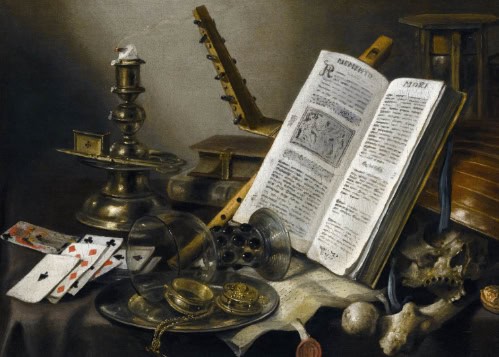
European Baroque painters (1600 to 1750) encouraged viewers to increase their consciousness of death by painting symbols, such as Dutch artist Pieter Claesz did in 1660. He depicted a toppled empty glass with nothing left in it to drink, a stopped clock, a burnt-out candle, the ace of spades playing card (that represents death), bones and a book with the title “Momento Mori”, meaning “Remember that you have to die.” Philosophers and artists of the time believed that cultivating a recognition of death would prompt people to live a more meaningful and moral life. I have always found the Vanitas paintings lush and beautiful, sobering and thought-provoking. I’m not sure, after viewing them, that I was any more ethical. However, I grew more conscious of life’s spark that blossomed in me at every moment; I didn’t take this energy source for granted as much.
As Steven Wright says, in this second, it seems I might live forever, for the vibrations of sensate reality feel timeless. As I grow older, my rational mind knows, with evermore certainty, that I approach death. I make my will and buy a niche at the local temple. At the same time, my inner child delights in the vibrant life force – the only energies I can immediately access.
The tastes, smells, voices and visions of this instant are all I can truly experience, minute by minute. My brain imagines the past or future and knows, intellectually, that I will eventually die. But this kind of knowledge differs from mental and physical sensory thrills. What a thorough conundrum nature gives us.
My solution is to look at the dichotomy in the face and laugh, like Steven Wright seems to do. I try to study abstract thoughts and balance them with the gripping phenomena of the present. I ponder knowledge of coming death and act on it: I downsize, leaving less stuff for my son to deal with. I understand that I will give up all my possessions one day, so I might as well start now.
There will always be a part of me that wants to indulge in pleasures: to savor eating, problem-solving, singing, drawing and dancing to celebrate the moments I have left. It’s important to do just that. At the same time, I face the facts of death’s eventuality by taking responsibility: by creating both spiritual and financial peace about my coming demise and by keeping my loved ones in the loop. It’s a tricky balance.
Kauffman’s painting, Purple Palm is currently featured in an online exhibit with the Walter Wickiser Gallery in New York. Use this direct link to see Kauffman’s work: https://www.artsy.net/viewing-room/walter-wickiser-gallery-kaethe-kauffman-flora/artworks
